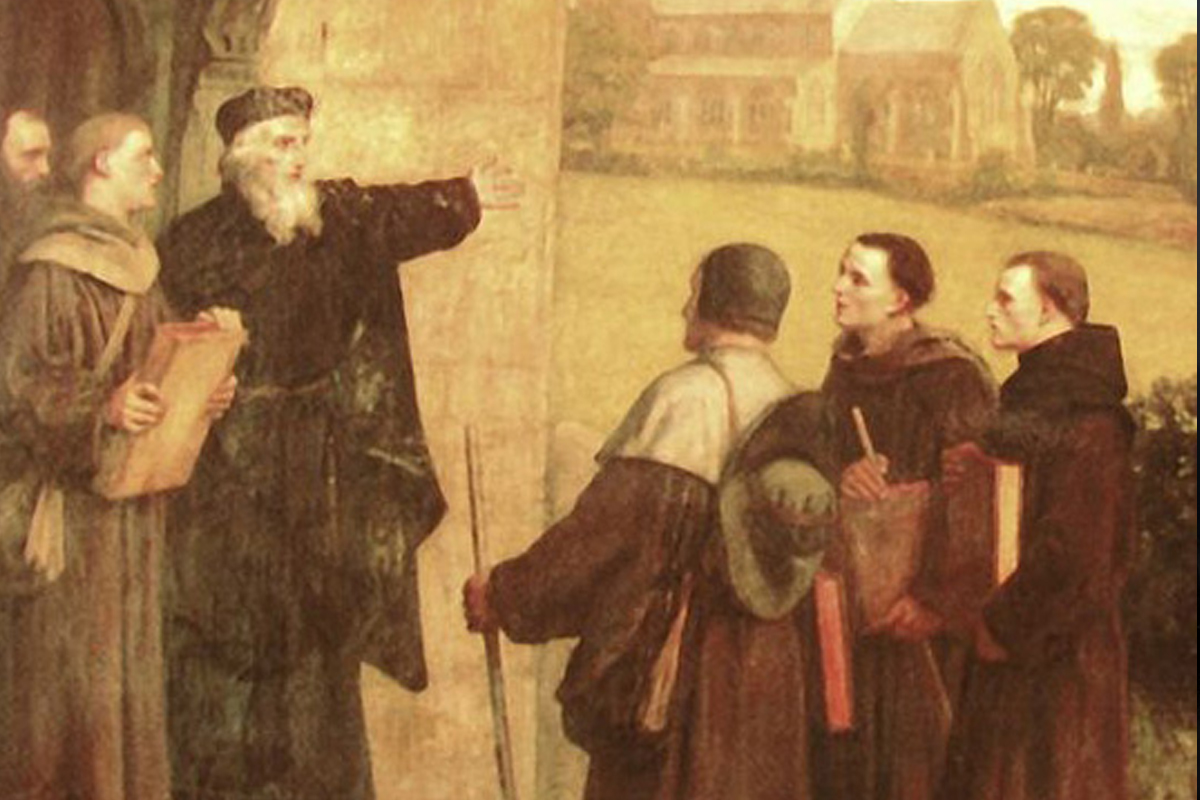
The 16th-century Reformation was a seismic shift in the landscape of Western Christianity, challenging long-held traditions and doctrines. At its heart lay a renewed emphasis on sola scriptura – scripture alone – as the ultimate authority. This principle, however, could not be fully realized while the Bible remained largely inaccessible to the common people, locked within the Latin of the Vulgate. The courageous and often perilous work of individuals like John Wycliffe and William Tyndale in translating the Bible into vernacular languages proved pivotal, igniting the flame of reform and forever altering the relationship between individuals and the sacred text.
John Wycliffe: The Morning Star of the Reformation
Nearly two centuries before the official start of the Reformation, John Wycliffe (c. 1330 – 1384), an English theologian and Oxford scholar, recognized the critical need for the Bible to be available in the language of the people. Appalled by the perceived corruption within the Church and advocating for a return to scriptural authority, Wycliffe spearheaded the first complete translation of the Bible into Middle English.
Working with his associates, notably Nicholas of Hereford and John Purvey, Wycliffe oversaw a translation process that was arduous and groundbreaking. Translating primarily from the Latin Vulgate, Wycliffe's Bible, though sometimes imperfect by modern linguistic standards, was a revolutionary act. It challenged the Church's control over biblical interpretation and empowered individuals to engage directly with the Word of God.
Wycliffe's efforts were met with fierce opposition from the Church establishment, which viewed the translation as a threat to its authority and feared the potential for misinterpretation by the uneducated masses. Despite condemnation and persecution of his followers, known as Lollards, Wycliffe's Bible circulated widely in manuscript form, planting the seeds for future reform and inspiring a hunger for scripture in the vernacular. He became known as the "Morning Star of the Reformation" for his early and courageous stand.
William Tyndale: The Architect of the English Bible
Two centuries later, William Tyndale (c. 1494 – 1536) took up the mantle, driven by an even more profound commitment to making the Bible accessible to every English speaker, even "a boy that driveth the plough." Unlike Wycliffe, Tyndale was determined to translate directly from the original Hebrew and Greek texts, bringing a new level of accuracy and linguistic sophistication to the English Bible.
Facing staunch opposition from both the Church and the English Crown, Tyndale was forced into exile, continuing his monumental work in secret across Europe. He published his groundbreaking translation of the New Testament in 1526, a landmark achievement that laid the foundation for the English Bible as we know it. His translation was not merely a linguistic transfer; Tyndale was a meticulous scholar who wrestled with the nuances of the original languages, seeking to convey their meaning with clarity and power in English.
Tyndale's work was smuggled into England and eagerly devoured, despite the authorities' attempts to confiscate and destroy copies. He went on to translate significant portions of the Old Testament before being betrayed and martyred for heresy in 1536. His final words, "Lord! Open the King of England's eyes," poignantly capture his unwavering dedication to making the scriptures available in English.
Challenging the Dominance of Latin
The translations of Wycliffe and Tyndale directly challenged the centuries-long dominance of Latin as the sole legitimate language of scripture in Western Europe. The Church had long maintained that Latin, as the language of the early Church and the Vulgate, was essential for accurate interpretation and served as a safeguard against heresy. By translating into the vernacular, Wycliffe and Tyndale undermined this authority and asserted the right of individuals to access God's Word in their own tongue.
Their work had profound and far-reaching consequences:
In conclusion, the courage and conviction of John Wycliffe and William Tyndale in translating the Bible into vernacular languages represent a watershed moment in Western history. Their tireless efforts, often at great personal cost, broke the linguistic barrier that had long separated the laity from the scriptures. By unleashing the Word of God in the languages of the people, they not only challenged the dominance of Latin but also laid an indispensable foundation for the Reformation and forever transformed the relationship between individuals, scripture, and the divine. Their legacy continues to resonate today, reminding us of the power of accessible language in shaping faith and understanding.